Baseline Testing
Relative Compression and Volumetric Efficiency — the first tests you run. Before you chase codes, before you swap parts, you need to know: can this engine do its job?
Why Baseline First?
Every diagnostic starts with a question: is the engine mechanically sound? You can spend hours chasing fuel trim codes, misfire counts, and sensor readings — but if the engine has a mechanical problem, none of that matters.
Baseline testing answers that question in minutes. A quick relative compression (RC) test tells you if all cylinders are contributing equally. A volumetric efficiency (VE) test tells you if the engine is breathing properly. Together, they give you a pass/fail on the engine’s ability to do work — before you go any further.
Think of it like checking vitals before surgery. You don’t start cutting until you know the patient is stable.
Relative Compression (RC)
The fastest way to check cylinder contribution without removing a single part.
What It Is
Relative Compression uses a current clamp on the battery cable (or starter circuit) during cranking. Each cylinder creates a predictable load on the starter as it comes up on compression. By measuring the current draw pattern, you can see — at a glance — whether all cylinders are doing equal work.
No gauge. No adapter. No removing spark plugs. Just clamp and crank.
How to Perform the Test
- Disable fuel and ignition (pull fuse, relay, or disable via scan tool)
- Place your amp clamp around the battery negative cable or starter feed
- Set your scope to capture cranking — typically 500ms/div, auto-trigger
- Crank the engine for 5-10 seconds
- Analyze the waveform — each current spike represents one cylinder’s compression event
Pro tip: Make sure the battery is fully charged. A weak battery will skew the results. If you’re not sure, do a battery test first.
What to Look For
✅ Known Good — Normal RC
All spikes are uniform in height and evenly spaced. Each cylinder is drawing the same amount of current during its compression stroke. This is what a healthy engine looks like.
→ Consistent peaks = equal cylinder contribution = engine is mechanically sound.
📷 Waveform: RC Known Good
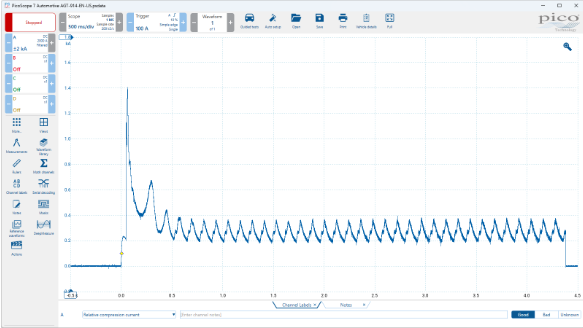
Consistent spikes, even spacing, uniform amplitude
⚠ One Cylinder High
One spike is noticeably taller than the rest. This cylinder is drawing more current — meaning it has higher compression than its neighbors. Could indicate carbon buildup, or the other cylinders may be low.
📷 Waveform: One Cylinder High
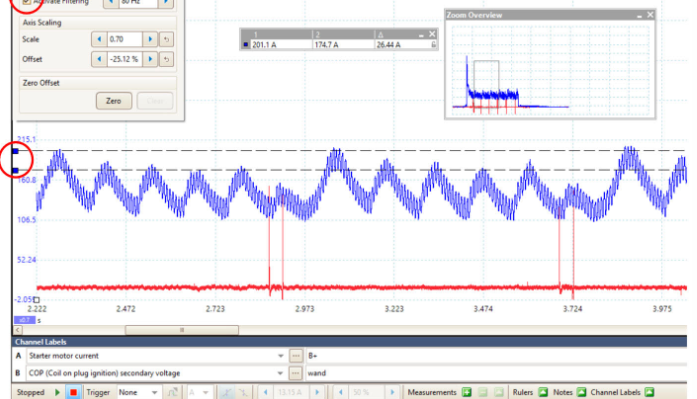
One spike stands above the rest — investigate further
❌ One Cylinder Low
One spike is shorter than the rest. That cylinder isn’t pulling its weight. This is a mechanical issue — could be a burnt valve, broken ring, head gasket leak, or worn cam lobe.
→ One low spike = one cylinder not contributing = mechanical failure confirmed.
📷 Waveform: One Cylinder Low
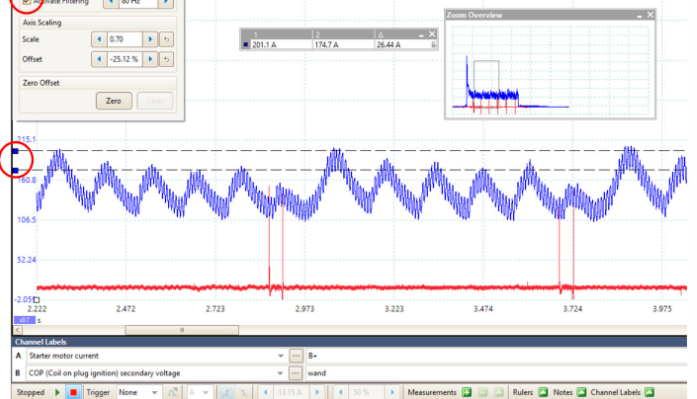
One spike noticeably lower — mechanical failure in that cylinder
Common Patterns & What They Mean
| Pattern | What It Means | Next Step |
|---|---|---|
| All spikes even | Engine is mechanically sound | Move to next diagnostic step |
| One spike low | Low compression in that cylinder | In-cylinder test, leak-down |
| One spike high | Higher compression (carbon?) or others low | Compare with VE, investigate |
| Multiple spikes low | Multiple cylinder issues | Head gasket, timing chain, major failure |
| All spikes low | Overall low compression or weak battery | Battery test first, then mechanical |
| Uneven spacing | Possible timing issue | Cam/crank correlation test |
Remember: This is one test. A good result gets you moving forward with confidence, and a suspect result begs more questions — more investigation. Follow the process. Don’t miss a step.
A Low or High RC should always be followed by a VE.
Volumetric Efficiency (VE)
How well is the engine breathing? VE measures the engine’s ability to fill its cylinders with air.
What It Is
Volumetric Efficiency is a calculation of how much air actually enters the cylinders compared to their theoretical capacity. A healthy naturally aspirated engine typically runs 80-90% VE at wide open throttle. Turbo/supercharged engines can exceed 100%.
Inconsistant VE means the engine can’t breathe — restricted intake, exhaust restriction, cam timing issue, carbon buildup, or valve problems.
When to Use VE
- After RC confirms equal cylinder contribution — engine is balanced but is down on power, missing, coding for missfire,
- Lack of power complaints that don’t show obvious codes
- Verifying a restriction — catalytic converter, intake, exhaust
- Confirming cam timing is correct (VVT systems especially)Carbon build that restricts, or hold a valve open
- Before and after repairs to verify the fix
VE Waveform Analysis
✅ Known Good — Normal VE
All cylinders contributing evenly. Consistent waveform pattern under acceleration. Engine is breathing properly — mechanically sound.
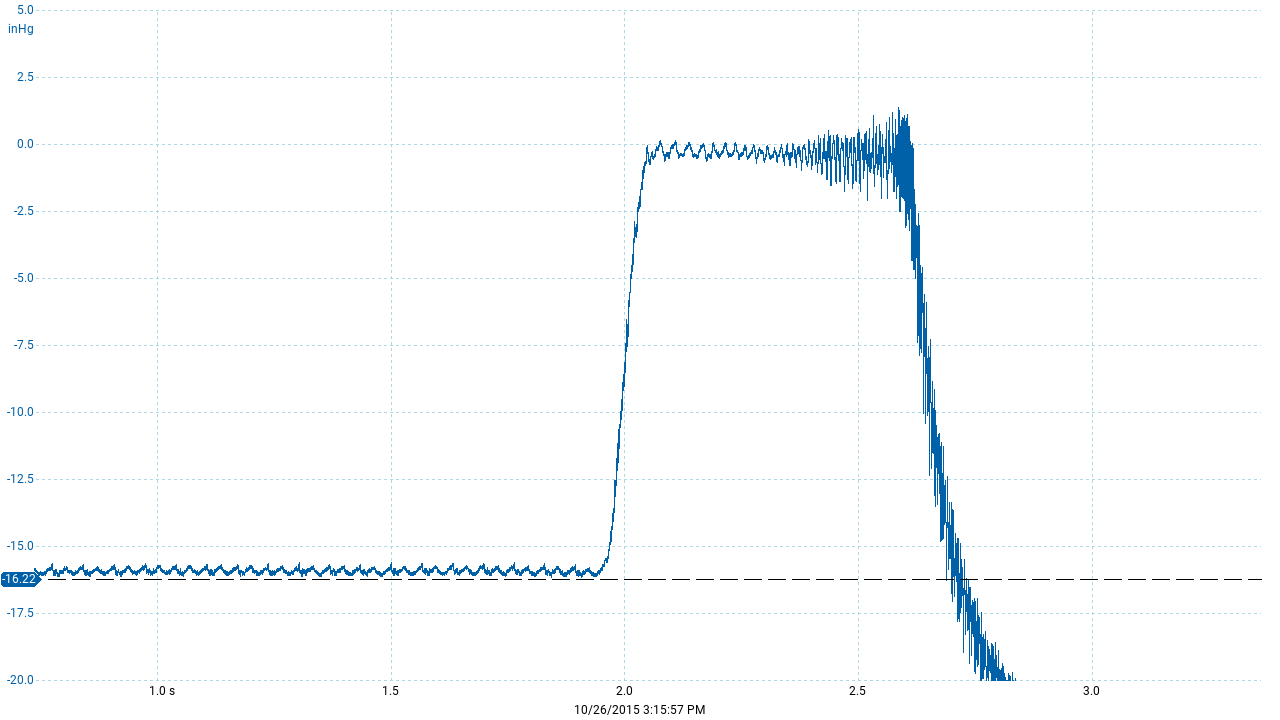
⚠ Marginal Condition
Some variance between cylinders. Could be mechanical wear, carbon buildup, or service-related. Warrants further investigation — not necessarily a failure, but not clean either.
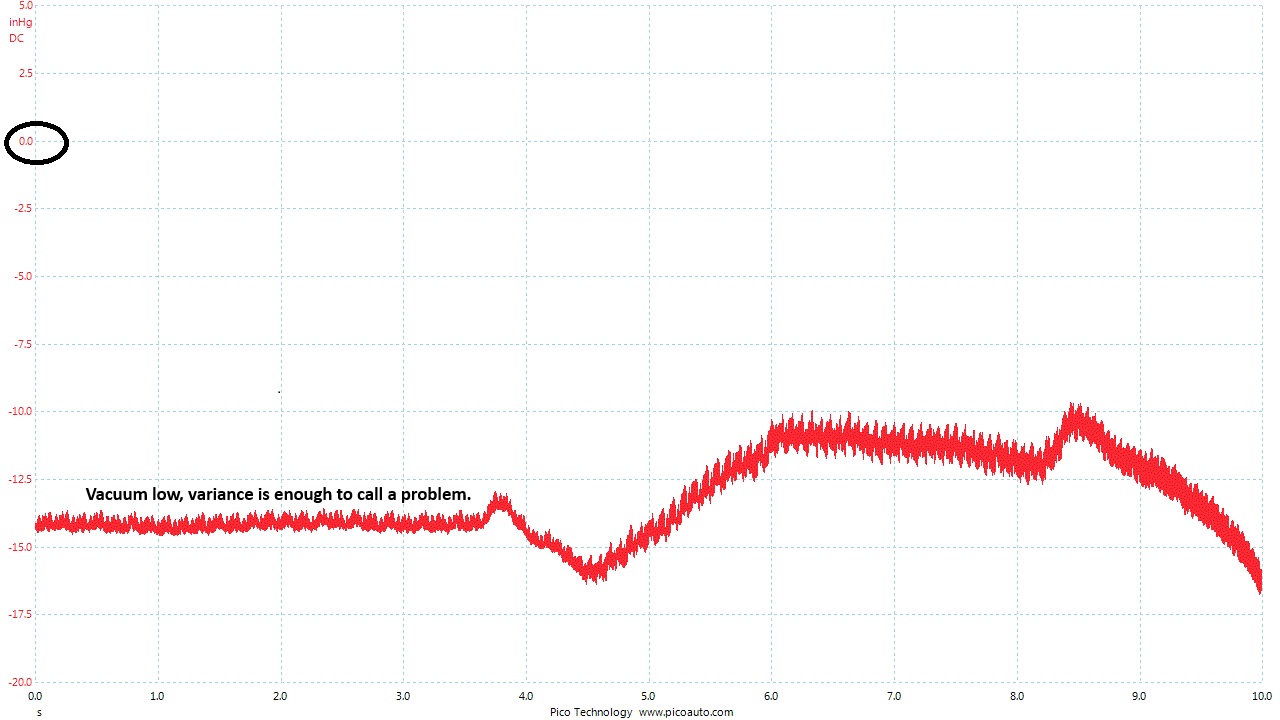
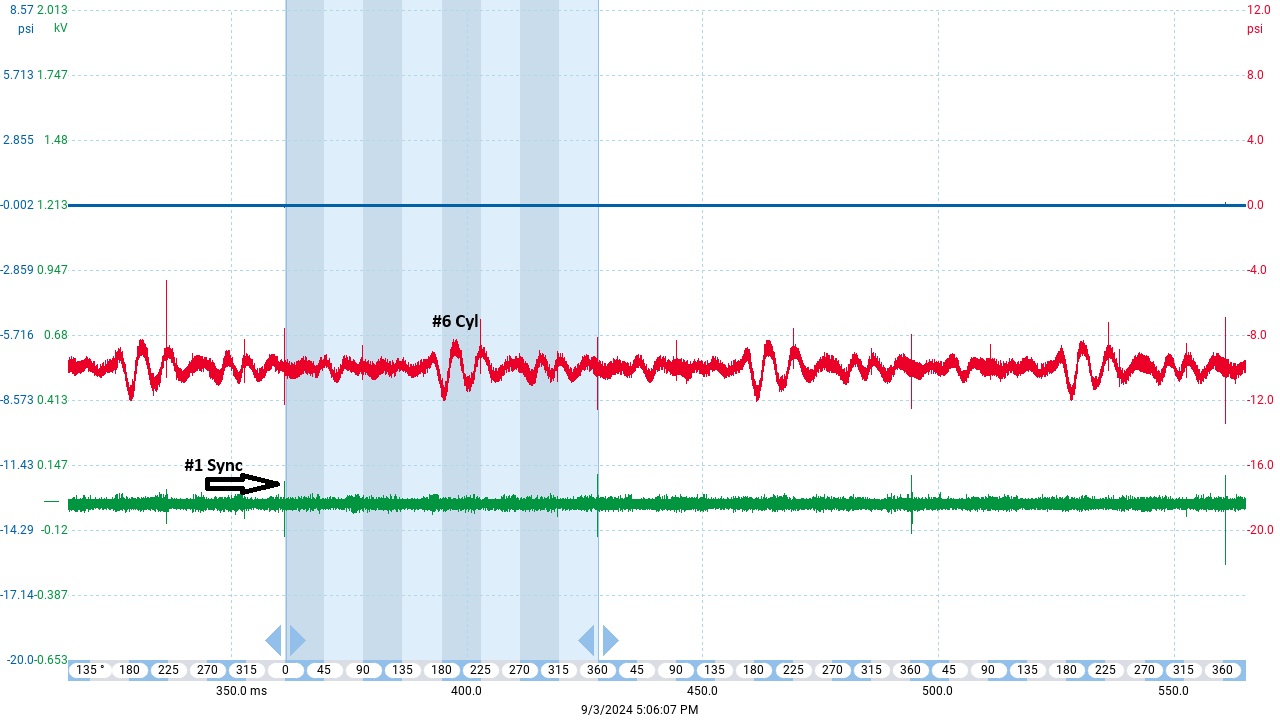
❌ Known Bad — Serious Variance
Obvious mechanical problem. Significant variance between cylinders. Applying sync may point to the offending cylinder. Further testing required — in-cylinder pressure transducer, leak-down, or physical inspection.
Equipment & Setup
What you need to perform baseline testing.
For RC Testing
- Oscilloscope (2+ channels preferred)
- High Amp Probe, 600–2000 Amps
- Fully charged battery
- Method to disable fuel & ignition
For VE Testing
- Use a WPS500, level 2
- Idle, high idle, snap throttle, and take off should be captured
- Stable idle readings tell the most, since it is at full vacuum
- Use before and after VE for confirmation and training
- VE can be subtle, and powerful
Recommended Scopes
- Pico Scope (industry standard)
- TiePei, Hantek
- MicSig
- Any scope with adequate sample rate
Key Takeaways
Rule #1: Always baseline first. It takes 2 minutes and can save you 2 hours.
Rule #2: RC tells you IF there’s a problem. In-cylinder testing tells you WHAT the problem is. Don’t skip steps.
Rule #3: A good RC doesn’t mean the engine is perfect. It means compression is equal. VE tells you if it’s breathing right.
Rule #4: Document everything. Save your waveforms. They’re your proof — for the customer, the shop, and yourself.
Waveform Gallery
More baseline waveforms will be added here as the library grows. Each one includes annotations and field notes.
RC One Cylinder Low — PicoScope Capture
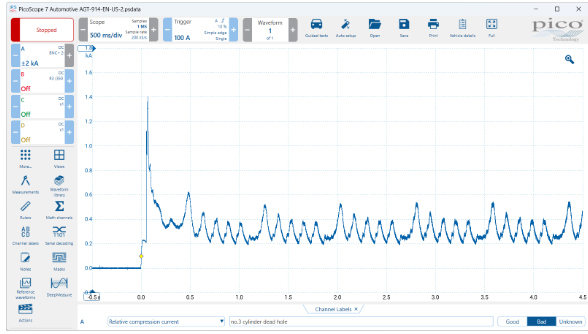
Field notes and story coming soon.
VE Pre-Repair — VW Misfire

From the Field: This VW came in missing, coding, not happy. This VE was one of the first things we did. Two plugs fouled, comp low on two cylinders. Cam timing was OK.
The fix: Carbon and oil cleaning services (BG of course). Saved this car for the owner.
📚 More waveforms coming — check back often
Have a baseline waveform to contribute? Send it in

